- Objectives
- Improve navigation and content discoverability for a diverse, multilingual community
- Deliver a fully accessible, responsive WordPress website aligned with public-sector standards
- Enable internal teams to manage content using flexible, reusable templates
- Preserve and modernize essential third-party integrations
- Results
- Launched a modern, accessible library website built on WordPress
- Migrated high-priority content into reusable, WCAG-aligned templates
- Enabled independent content management through training and documentation
- Preserved and enhanced integrations including Bibliocommons, Bookflix, EBSCO, New York Times, and more
You can access the Richmond Public Library website at https://www.yourlibrary.ca/
Project Background
Richmond Public Library’s website is a critical public service tool. It supports access to programs, digital collections, branch services, and essential information for a large and diverse community. Over time, the site had grown to support many needs, but that growth introduced challenges around navigation clarity, content duplication, and maintainability.
The library initiated a full library website redesign as part of its broader 2024–2028 Strategic Plan, with a focus on reducing barriers to access, improving discoverability, and strengthening the digital customer experience.
The goal was not simply a visual refresh. The mandate was to create a user-focused, accessible WordPress website that could evolve with the organization while remaining practical for staff to manage.
Research & Discovery Strategy
As with all public-sector projects, research and accountability formed the foundation of this engagement. Brain & Code partnered closely with RPL to ensure design and development decisions were grounded in evidence, not assumptions.
Stakeholder Alignment and Scope Definition
The project began with a structured discovery phase aligned to the approved statement of work. This phase established shared understanding around scope, governance, accessibility requirements, and success criteria.
Key activities included:
- Stakeholder workshops with leadership, communications, and digital teams
- Review of content workflows, ownership models, and update constraints
- Identification of required integrations and technical dependencies
- Alignment on accessibility and compliance expectations
Analytics-Driven Insights
To support a data-informed library website redesign, Brain & Code reviewed a full year of Google Analytics 4 data. Findings and recommendations were documented in a dedicated Analytics & Content Strategy report, which informed page prioritization, navigation emphasis, and user experience (UX) decision-making across the project.
The analysis confirmed that the website serves a highly task-driven public audience. Most users arrive with a specific goal, such as accessing citizenship or driving practice tests, checking hours and locations, applying for a library card, or using Wi-Fi. These services consistently represent the highest traffic and engagement, reinforcing the need for clear, direct access to essential tasks.
The data also showed that the homepage is not the primary entry point for many users. A significant portion of traffic enters the site directly on service or resource pages through search. This insight shaped a strategy where key landing pages are designed to function independently, with clear context, accessible structure, and intentional next-step pathways, rather than relying on users to navigate back to the homepage.
Engagement patterns highlighted a clear distinction between quick-service pages and deep-engagement content. Some pages are designed for fast task completion, while others, such as practice tests and special collections, demonstrate sustained user attention once discovered. Recognizing this difference ensured that UX decisions respected task efficiency while identifying opportunities to reduce dead ends and support appropriate follow-on actions.
From a technology standpoint, usage data confirmed the importance of balanced mobile and desktop optimization, supporting a wide range of devices, screen sizes, and browsers typical of public-sector audiences.
Together, these behavioral insights established what mattered most to users and where friction occurred, setting the foundation for the subsequent content audit and information architecture work.
Content Audit and Information Architecture
Building on the analytics findings, Brain & Code conducted a comprehensive content audit to evaluate what content existed, how it was structured, and whether it continued to serve user needs and organizational goals.
This phase focused on the structural health and sustainability of the website, rather than user behavior alone.
Deliverables from this phase included:
- A detailed content inventory highlighting priority, redundant, and outdated pages
- Information architecture recommendations to reduce duplication and excessive nesting
- Clear grouping of services, programs, and digital resources based on user intent
- Content governance guidance to support long-term maintainability and consistency
The audit revealed opportunities to simplify overly complex page hierarchies, consolidate overlapping content, and improve clarity through more descriptive labels and cleaner groupings. These recommendations directly informed the revised site map, navigation structure, and page template strategy.
By separating behavioral insight from structural evaluation, the project ensured that decisions about what to keep, remove, or reorganize were grounded in both how the public uses the site and how the content is managed internally. This approach reduced risk, improved clarity, and established a scalable foundation for ongoing growth.
Public Consultation and Community Input
Community and staff surveys played a critical role in shaping the library website redesign, providing qualitative insight into how the website is experienced by both patrons and frontline staff. The findings were documented in a dedicated Survey Results & Insights report, drawing from over 1,700 community responses and 50 staff responses.
Across both groups, participants consistently emphasized the importance of clarity and ease of use. Patrons described the existing site as cluttered or difficult to navigate, particularly when trying to find programs, events, or specific services. Many expressed frustration with abstract labels, overlapping categories, and the need to click through multiple pages to reach basic information. Requests focused less on new features and more on making existing services easier to locate and understand.
Staff feedback closely aligned with public input. As frequent daily users of the website, staff highlighted challenges with inconsistent structure, unclear terminology, and buried content. They emphasized the need for a more predictable layout, clearer grouping of services, and a site that better reflects how patrons ask questions in person. Staff also noted the importance of a website that is easy to update and explain to customers at service desks.
Taken together, the survey findings reinforced several key principles for the redesign: the need for task-based navigation rather than organizational labels, plain-language terminology in menus and headings, improved event discovery and filtering, and inclusive design decisions that support different levels of digital literacy and language access. This consultation ensured the new WordPress website was shaped not just by internal goals, but by the lived experience of the community it serves.
Approach & Solution
Research-Led WordPress Website Design and Development
With discovery complete, Brain & Code moved into WordPress website design and development with a clear mandate: translate research, analytics, and stakeholder input into a calm, intuitive experience that works for real users and real operational constraints.
Navigation and Wayfinding for a Library Website Redesign
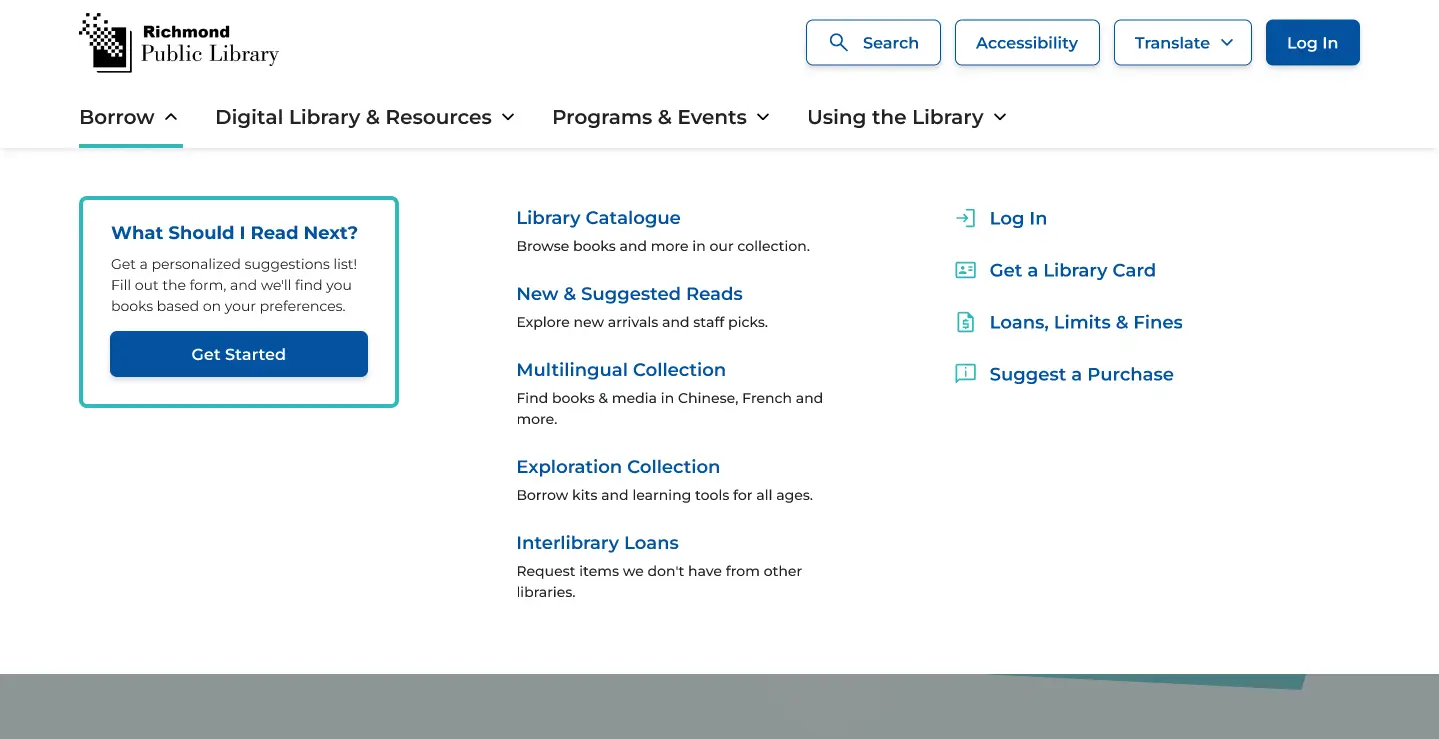
Navigation was restructured to support task-based discovery rather than internal organizational structures. The redesigned mega menu uses clear hierarchy, descriptive labels, and scannable groupings to reduce cognitive load and improve findability across desktop and mobile.
Homepage Strategy as a Functional Service Hub
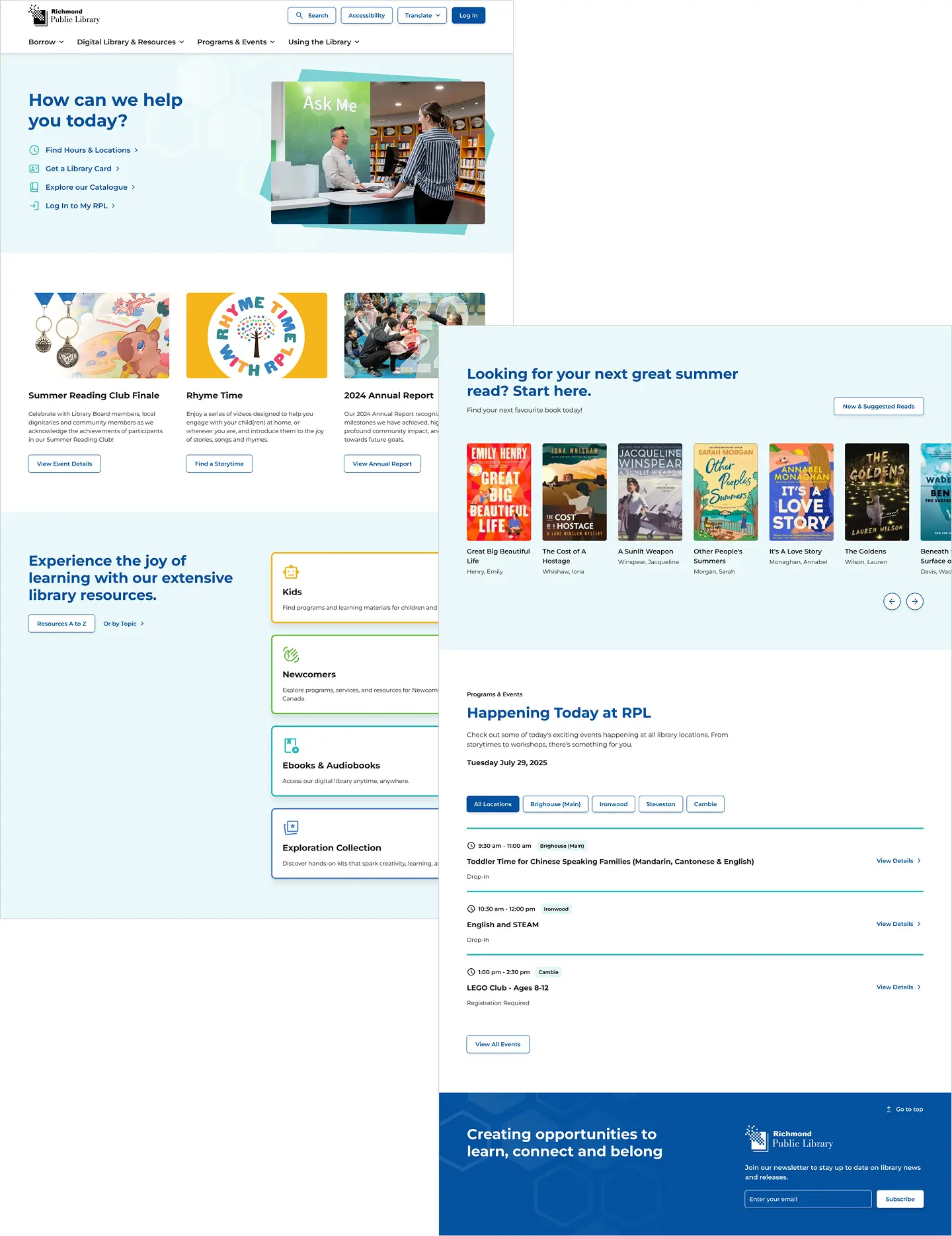
The homepage was designed as a functional hub rather than a promotional page. It prioritizes high-value actions such as catalogue access, account login, library card applications, and hours and locations.
Flexible feature sections allow RPL to highlight programs and campaigns over time, while a “Happening Today at RPL” section surfaces same-day events across branches to keep the page current and useful.
Digital Collections and Resource Landing Pages
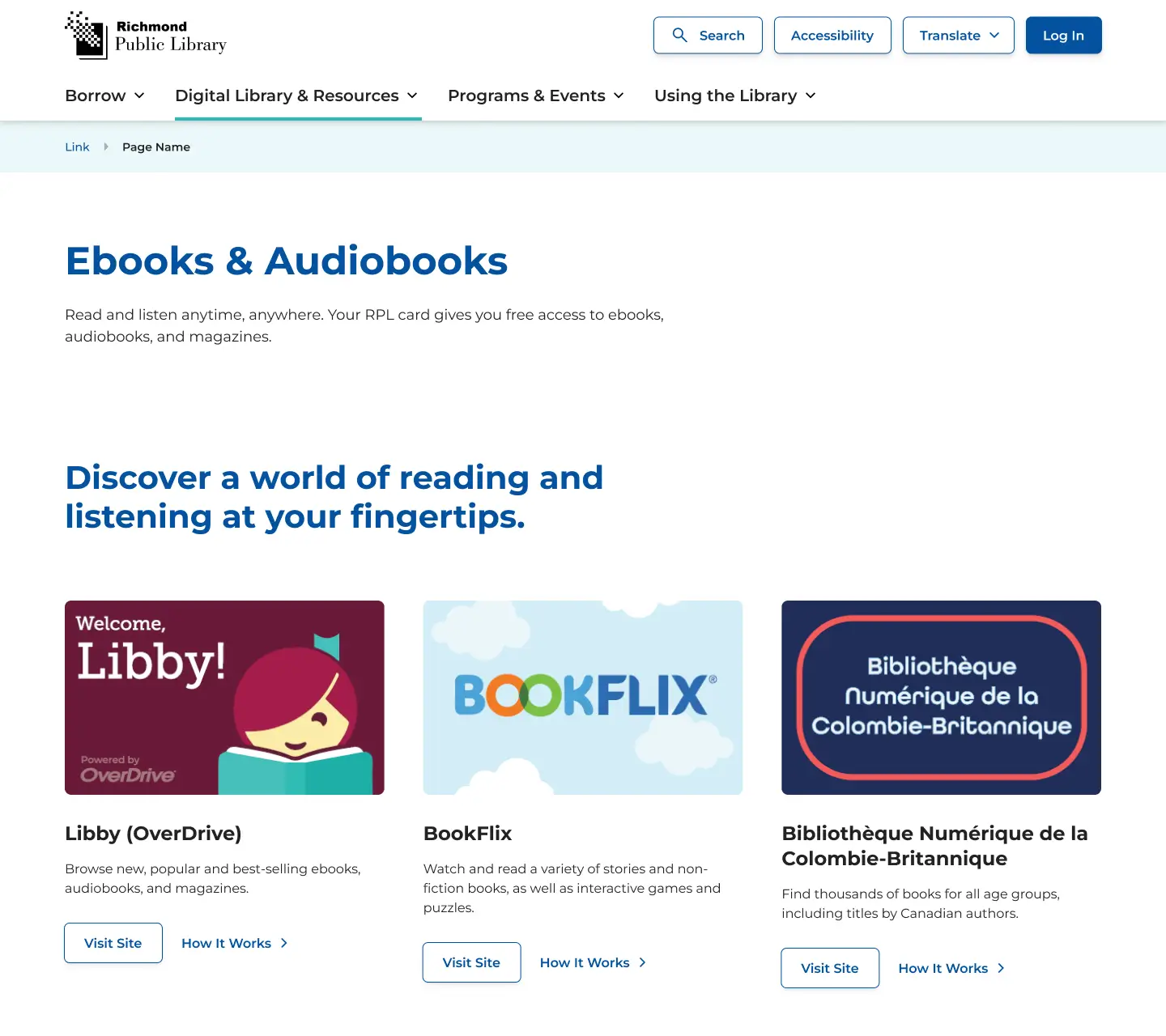
Digital resources such as eBooks, audiobooks, movies, and online learning tools are supported by intermediary landing pages that explain what each service offers before sending users off-site.
For frequent users and staff, Resources A–Z and Resources by Topic pages provide structured, fast access to the full digital library using alphabetical and topic-based jump links.

Editorial Discovery Through New & Suggested Reads
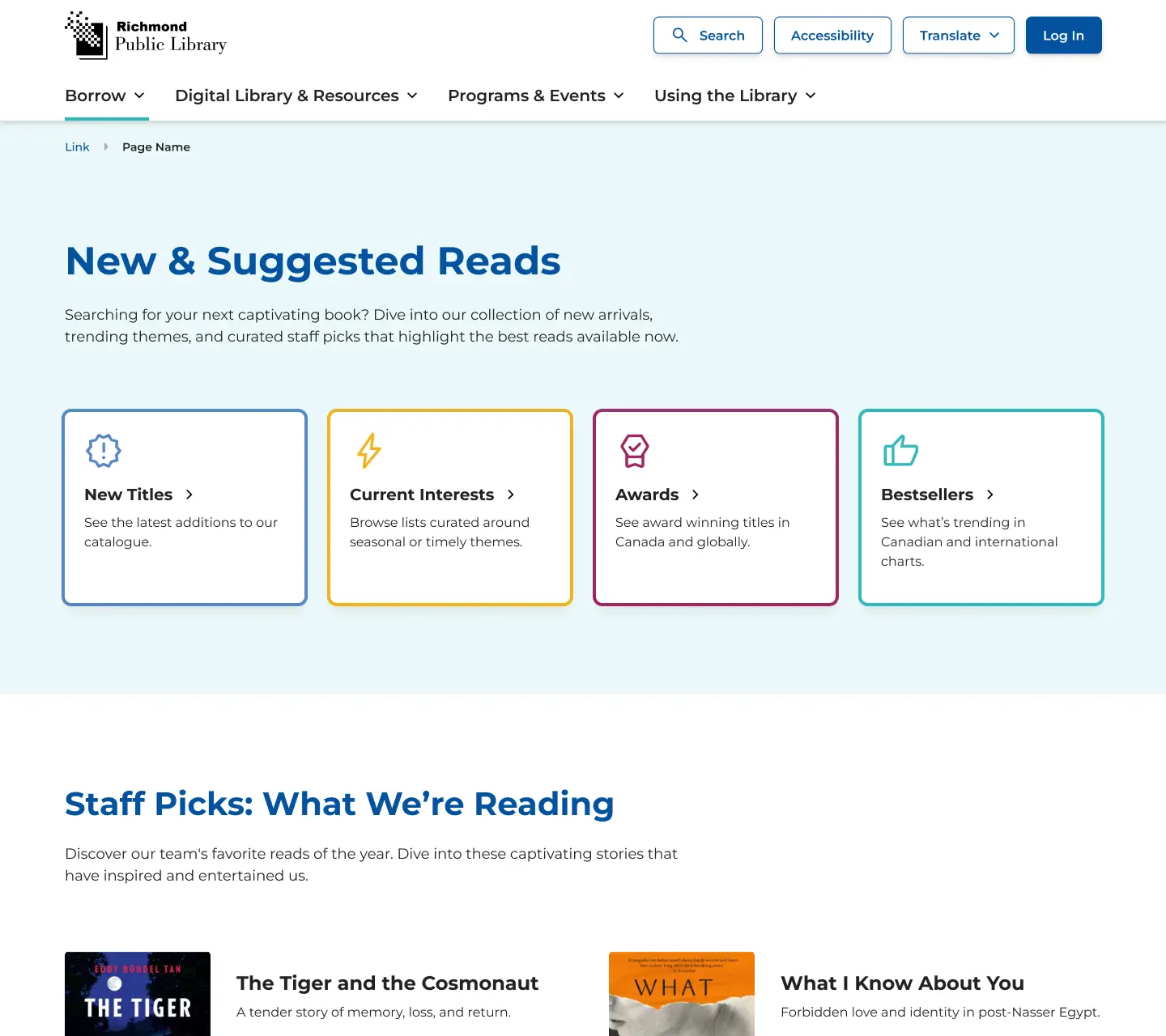
The New & Suggested Reads landing page centralizes book discovery and staff expertise. It combines curated Bibliocommons lists, staff reviews, and themed reading lists in a way that feels editorial and human, without duplicating catalogue functionality.
Audience-Focused Landing Pages
Audience pages such as Kids, Adults, Seniors and Newcomers were designed as long-form, scannable landing pages that bring together programs, collections, and services in one place. Jump links, filtered event sections, grouped resources, and accordion content reduce scroll fatigue while supporting exploration.
Location-Based UX for Hours and Branch Information
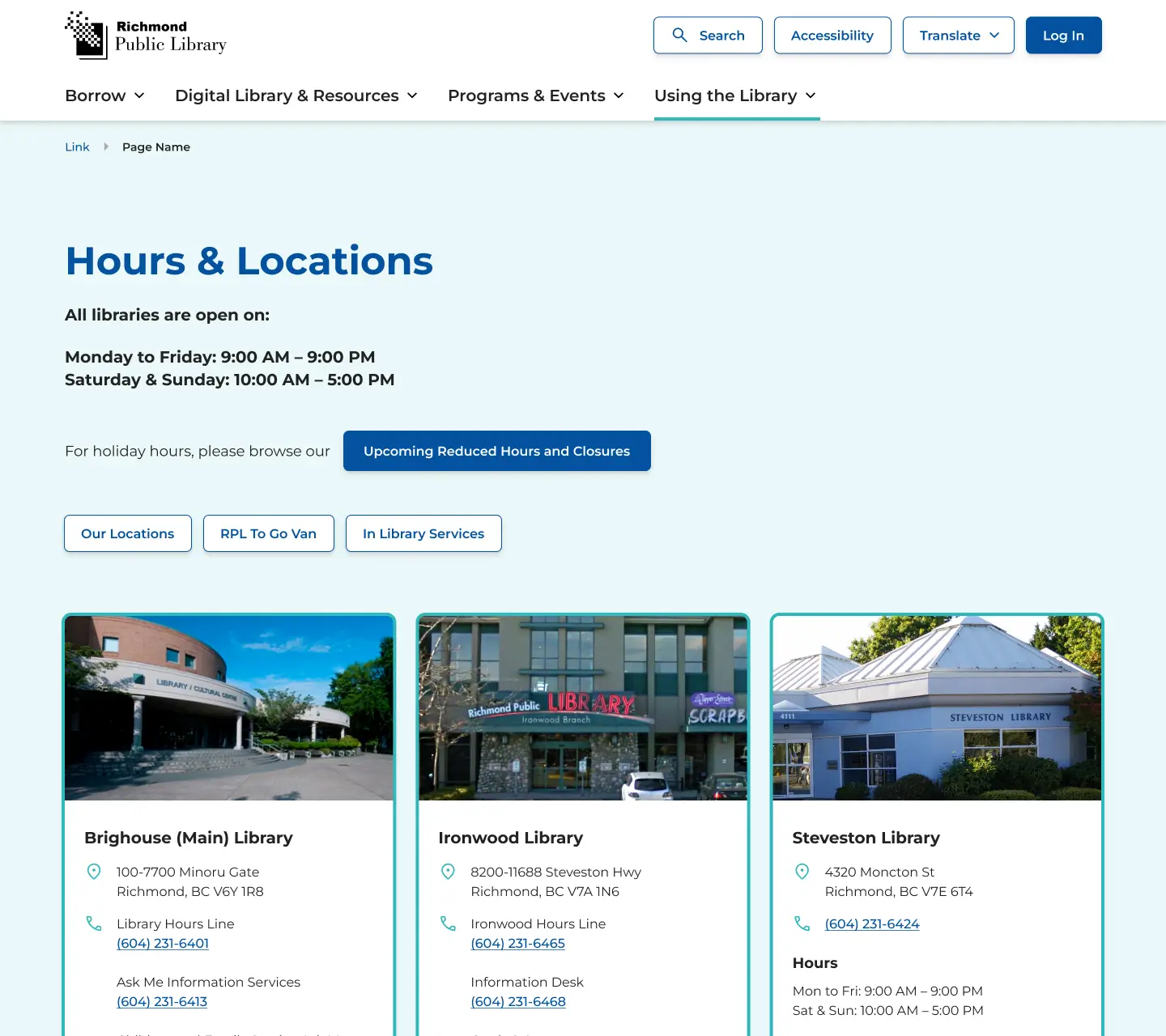
The Hours & Locations page was rebuilt to answer two core questions clearly: when branches are open and what services are available at each location. Shared hours were consolidated, holiday closures grouped by month, and branch-specific services highlighted through clear visual tags.
Reusable Content Templates in WordPress
Rather than relying on one-off designs, the site is powered by a modular system of reusable templates. A base content page supports policies, services, and informational content with accessible heading structure, readable spacing, and optional calls to action.
This approach allows internal teams to create new pages without design or development support.
Forms and Task Completion Flows
High-impact forms such as library card applications, tour requests, and citizenship practice tests were redesigned for clarity and accessibility. Success pages were treated as intentional moments, providing confirmation and relevant next steps rather than dead ends.
Government Website Accessibility and Multilingual Support
Accessibility was addressed throughout design and development, not treated as a final checklist. Templates were built to support keyboard navigation, readable typography, clear contrast, and responsive behavior across devices. Existing assistive tools such as ReachDeck were retained and integrated into the new experience. Multilingual access was expanded using Google Translate to better serve Richmond’s diverse population.
Technical Delivery
From a technical standpoint, Brain & Code developed a custom WordPress theme with modular templates, configured plugins, supported server setup, and ensured SEO continuity through structured redirects. Critical integrations such as Bibliocommons, Bookflix, EBSCO, and New York Times were preserved and visually aligned with the new site so they feel cohesive rather than disconnected.
Training, Documentation, and Knowledge Transfer
As a WordPress agency with deep experience building complex, high-traffic websites, Brain & Code places strong emphasis on sustainability and operational handover. Training sessions and clear documentation were delivered to ensure RPL staff could confidently manage content, templates, and plugins long after launch, without ongoing developer dependency.
Why This Matters for Other Libraries and Municipalities
Public-sector websites are held to a higher standard. They must be accessible, easy to use, transparent, and sustainable over time, often with limited internal resources.
This library website redesign demonstrates how a research-led WordPress website design approach can deliver measurable improvements without adding operational complexity.
Key takeaways for libraries, municipalities, and non-profits:
- Research reduces risk: Analytics, staff input, and public consultation helped prioritize the right pages, labels, and user journeys before design and development began.
- Accessibility must be built in from day one: Government WordPress accessibility is most effective when templates, components, and content workflows are designed with WCAG requirements in mind, not added later.
- Task-based navigation outperforms organizational structure: Users arrive with goals. Structuring navigation around real tasks improves findability and reduces frustration.
- Flexible templates scale better than custom pages: A modular WordPress system allows internal teams to create new pages and campaigns without redesign or developer support.
- Third-party systems can feel cohesive: With the right UX strategy, integrations like catalogues, event systems, and booking tools can feel connected rather than fragmented.
- Staff enablement is part of the deliverable: Training and documentation ensure the website remains usable, consistent, and up to date long after launch.
For public institutions planning a website redesign, this approach balances compliance, usability, and long-term maintainability, while respecting the realities of internal workflows and evolving community needs.
Conclusion
This project demonstrates what is possible when a library website redesign is grounded in research, public consultation, and accessibility-first thinking.
For libraries, municipalities, and non-profit organizations, websites must balance compliance, clarity, and operational reality. They must serve diverse audiences, meet accessibility standards, and remain manageable for internal teams over time.
Brain & Code is a WordPress agency specializing in WordPress website design and development for public-sector and mission-driven organizations. Our work is shaped by research, stakeholder listening, and a focus on delivering streamlined, effective solutions.
If your organization is planning a website redesign or accessibility initiative, contact Brain & Code to discuss your project.